Week of Sept. 6-12, 2026
Last week we talked about some of this month's larger and more familiar constellations in the eastern sky after dark. Today, however, I'd like to tell you about some of those that rarely get the same attention.
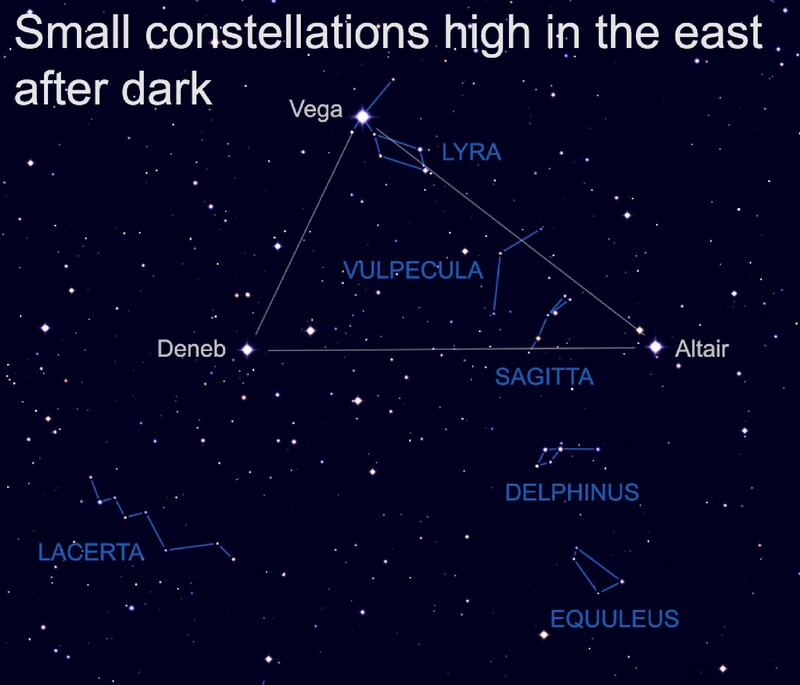
A great starting point for this exploration is the Summer Triangle, which, by now, I'm sure you know well. During early evening hours this week, it lies high in the eastern sky and is outlined by the three bright stars Vega, Deneb and Altair.
Nearby and within this obvious geometric shape appear six of the smallest and most obscure constellations in all the heavens. Five form a line across the triangle that begins near Vega with Lyra and ends with Equuleus lowest in the sky. These are tough to find even in dark skies, but they're still fun to seek out if you get the chance.
Let's start at the top, near the bright star Vega, with the easiest of the bunch to find: Lyra, the harp. In ancient Greek mythology, the Lyra represented the lyre (or harp) invented by Hermes and subsequently given by his half-brother Apollo to the great musician Orpheus.
Just below, and mostly within the triangle itself, lies Vulpecula, the fox. In the 17th century, the Polish astronomer Johannes Hevelius introduced Vulpecula with a celestial companion, and was named Vulpecula cum Anser, or Fox with Goose. Oddly, however, the fox remains, but the goose no longer appears on modern star charts. I'll leave its fate to your imagination!
Below Vulpecula we see Sagitta, identified as a stray arrow shot by Apollo to kill the Cyclops, or occasionally seen as one of Cupid's arrows. This is the smallest of all constellations in the sky, and it has no stars bright enough to see easily from under city or suburban lights.
Next in line comes one of my favorites: Delphinus, the dolphin. This group of five stars may have originated in ancient Greece and, amazingly, looks like a tiny dolphin leaping from right to left out of the water. It is said that, when Poseidon, god of the sea, wanted to marry Amphitrite, she became so disgusted at the thought of living under water that she fled to the distant Atlas Mountains. Poseidon sent several messengers after her in hopes that she might return to him; it was only the Delphinus who succeeded, and it was rewarded with a place in the heavens.
Now scan the sky just below Delphinus, and see if you can spot the few faint stars that represent Equuleus, the little horse, the second smallest constellation in all the heavens. This is a tough one, and you'll find Equuleus is hard to find even under the darkest of skies.
The final small star grouping is Lacerta, the lizard. You can find its zigzag shape below and to the left of the bright star Deneb, more to the northeast. Along with Vulpecula, this constellation was also created by Hevelius and first appeared in his 1690 atlas titled "Firmamentum Sobieski." So why did Hevelius create it? For a very practical reason: to fill a tiny area of the sky in which no other constellation would fit!
Visit Dennis Mammana at dennismammana.com. To read features by other Creators Syndicate writers and cartoonists, visit the Creators Syndicate website at www.creators.com.
The Summer Triangle, formed by the bright stars Vega, Deneb and Altair, lies high in the eastern sky during early evening hours this week.







View Comments